
By Corey Frey, Pattern Design Manager, Fellers
With more than 2,600 vehicles in the DigiCut library, it’s a fair question. Why hasn’t every one of those vehicles gotten a matching windshield pattern? The short answer goes back to how this business started.
The short answer
When we began designing templates 28 years ago, film technology wasn’t nearly as advanced as it is today, and our primary customers were new car franchise dealerships rather than local install shops. Windshields weren’t part of that early demand, so the library grew without them. That history is still shaping the library today, even as the market around it has changed.
Why windshields are their own challenge
Side and rear glass templates are complicated enough. Windshields raise the difficulty considerably, for a few real reasons.
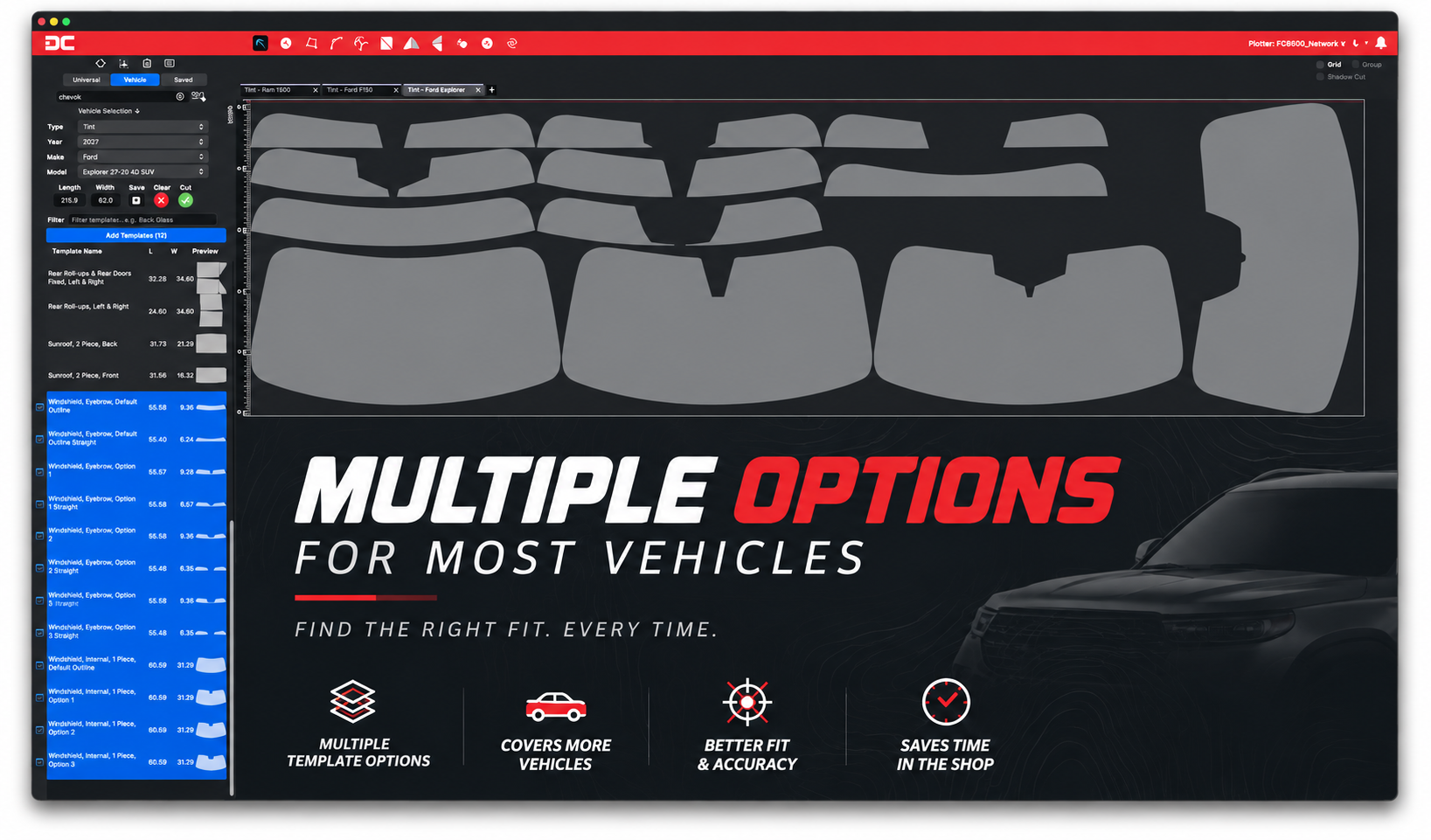
Part numbers multiply fast. The Ford F-150 currently has 13 different windshield part numbers. The Jeep Grand Cherokee has 23. Some of those variations differ by less than half an inch, which makes it genuinely hard to know which option a given vehicle needs, even with several choices already available in the library.
Trim levels and factory accessories change the shape of the template too, so a base model and a loaded trim on the same vehicle year can call for different templates.
Then there’s the glass itself. Windshields get replaced often, and once a vehicle has aftermarket glass instead of OEM, the fit can shift enough that a template built for factory glass no longer sits right. We’ve seen this play out repeatedly. OEM and aftermarket glass look similar, but they’re frequently different enough to notice.
Modern vehicle technology adds another layer. Lane departure warning, forward collision alert, and rain sensors have all advanced significantly, and tint installation near these systems can interfere with how those electronics work. Add in the electrical components mounted to the firewall, where moisture during installation can cause expensive damage, and you can see why windshield work has stayed a hand cut specialty rather than a standard software template for most vehicles.
Visor coverage ran into a similar wall for years. We held off on visors because the laws governing them vary from state to state, and getting that wrong carries real consequences.
The legal side matters as much as the fit
Windshield tint sits in a heavily regulated space, and it’s worth treating that seriously. Federal standards call for a net VLT, or visible light transmittance, of 70 percent once film is applied to a windshield. That’s why the films that actually work on a windshield generally need a VLT rating above 80 percent themselves, high enough that even after layering onto the glass, the combined result still clears the federal floor. State laws add another layer on top of that, and they don’t all match. Confirm the current rules in your state before tinting any windshield. Getting this wrong can open a shop up to real liability, not just an unhappy customer.
Where things stand now
Despite all of that, the library has been growing. Over the last two years, we’ve added at least one windshield option for vehicles going back to the 2014 model year, and we’re going to keep adding them as the technology allows it. Infrared filtering films now exist that clear 80 percent VLT and still perform the way customers expect. As those films become more available, more vehicles make it into the library. Just as important, we listen when our users ask for a specific vehicle, and we build it when we can.
What this means for your shop
Until a vehicle has a template available, windshield work stays a hand cut job. For a shop willing to develop the skill, that is real opportunity. It takes genuine technique, and customers notice the difference between a shop that can do it well and one that can’t. As more templates roll out through DigiCut, you get both the software backing you up and the hand skill to fall back on for vehicles that still need it.
Want to check on a specific vehicle? Reach out to a DigiCut rep. If we don’t have a windshield option for a vehicle you’re working on, let us know. That request is exactly how new options make it into the library.